

Research
Theory and methods
The theoretical framework of the globalization of politics extends cleavage theory to the global level by conceptualizing the politicization of unequal cultural, political and socio-economic rights. It adapts the concept of cleavage – so far limited to formed nation-states and the forming European polity – to the unformed global arena by postulating the emergence of global cleavages under conditions of closure drawing on exit–voice models of political structuring in macro-historical comparative politics.
Based on theories of nationalization and Europeanization, the framework establishes the conditions under which territorial and territorialized global cleavages are replaced by cross-territorial functional ideological oppositions. This “transition” is modelled in processes of convergence of regional cleavage structures (comparative approach) and linkage between similar groups across borders coordinating organizationally, developing shared identities and manifesting solidarity (transnational approach).
- Theoretically, by bridging comparative politics and IR, the conceptualization conceives of global integration in politicized terms, transcending the alternative between de-politicized technocratic integration and politicized disintegration.
- Normatively, it points to the possibility of plural representation through global institutional channels.
- Empirically, it guides the analysis of the long-term evolution of territoriality in the world state system since the inception of global trade, colonization and mass politics in the 19th century. This framework in presented in two related papers, one focussed on territoriality and one on dimensionality.
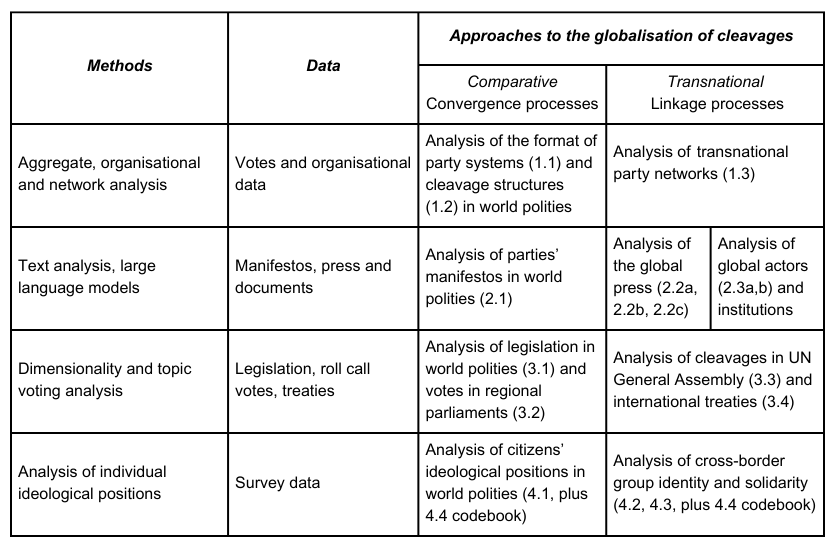
The following methods are used in the project: statistical analysis based on voting and organizational data; network analysis of political actors and states treaties, text analysis using large language models based on manifesto data, legislation, programmes by national and global actors; dimensionality analysis of roll-call votes and parliamentary debates; analysis of attitudes and behaviour at individual level through survey analysis; qualitative comparative analysis; classification and coding using artificial intelligence.
Project activities
Research for the GLOBAL project is organized into four work packages based on different methodologies:
- WP1: national and regional party and cleavage systems, global networks and transnational parties;
- WP2: text analysis with large language models of manifestos, global actors and international organizations;
- WP3: legislation and roll-calls analysis in national, regional and global assemblies, and international treaties;
- WP4: global survey of 12 world polities on transnational groups, identities and political action
Within each work package, a number of tasks are distinguished based on cross-country comparative and transnational approaches. The comparative approach covers the following polities: Brazil, China, Egypt, Europe (taken as a whole), India, Indonesia, Japan, Mexico, Nigeria, South Africa, Turkey, United States. The transnational approach focuses on supra-national actors and international organizations.
Research is regularly presented at conferences, with working papers and articles in scientific journals.
GLOBAL also organises workshops and invites scholars to present related work and build an international network.
Data, codes and codebooks produced during research will be available through this website upon publication of empirical results.
Results are presented in the GLOBAL Working Paper series and in subsequent journal articles. At the end of the funding period, the project will lead to a book on “The Globalisation of Politics” by the PI that follows on common theoretical foundations the books on the nationalisation and Europeanisation of politics (Cambridge University Press, 2004 and 2015).
Preliminary findings
Findings are presented in journal articles and books. On this page, graphs depictions of a selection of preliminary results, accompanied by brief commentary are provided. If used, the source must be cited (PI, name of the project and web link).
Resources
Data, codes and code-books produced during research will be available through this website upon publication of empirical results toward the end of the funding period.